
Creating “spaces for oneself” in order to build community
Sarah Gamrani & Laure Togola · July 1, 2023
archivesEarly in 2023, a friend first mentioned the party to us: “Have you heard of P3?” Next, images started popping up on our Instagram feeds: flashes of sweat, bodies moving to the music. Then we met Habibitch backstage in Geneva: “I’m a host at P3 – have you heard of it?” Each time it was mentioned, there was the same sparkle in the speaker’s eyes. Once again, an Instagram story or a video recap catches our eye – sometimes, the algorithm gets it right. After a few scrolls, captivated by the visual aesthetic that the three founders – Mariana, Stencia, and Sephora – had created around their iconic themed parties, it became clear to us that the long-form format we were looking for for the second issue of Flashes (released in July 2023) was right before our eyes.
It was a unique party space that existed from autumn 2022 to winter 2024, created by three badasses who moved in Parisian artistic circles: Mariana, Stencia and Sephora. Through this collaborative project, they embodied the values we wanted to explore in that issue regarding the creation of inclusive and safer party spaces. In late March 2023, they took the time to share their inspiring, funny, and deeply committed experiences with us, telling us all about P3: closed-doors parties organized by and for all people who identify as women, and especially queer and racialized communities. We left this interview deeply moved by the sincerity, radicalism, and kindness of these three Parisian nightlife icons, but above all with immense joy at seeing that glimmers of hope were already very much present in our nights. A profound transformation of club culture was in action.
The party came to an end in 2024, but the mark it left on memories and bodies is indelible.
Hello Mariana, Stencia, and Sephora. Thank you for taking the time to talk to us about your joint project: P3. First of all, how did you meet, and why did you decide to create P3?
Mariana : Stencia and I have known each other for a long time, we actually live together. One night, we were hanging out in the Marais and going with some gay friends to a party, when we realized we didn’t have a space of our own to go dance, have fun, and meet girls. We have huge respect for parties exclusively for gay guys, but we thought it’s a shame that we don’t have a place of our own that reflects who we are. For example, the experiences we’ve had in clubs at lesbian parties, which were mostly white and butch, just didn’t feel right for us – both in terms of vibes and musical styles.
Around the same time, I met Sephora, back when she was working at Wanderlust, and she shared this same desire to create a women-only party that reflects who we are. We talked it over and said to ourselves: let’s do it together!
Stencia : Exactly! We all share the same values. All three of us are queer people of color. And another important thing is that we all love the same music – shatta, dancehall, R&B, bad-bitch hip-hop, baile funk, and Afrobeats.
Sephora : And all three of us are very active advocates on issues that vary depending on our individual concerns. That’s what makes us women who are committed to the cause on all fronts. We’re outraged, and we speak our minds. (laughs)
Mariana : We’re angry, but that’s a good thing – it’s through this anger that we come together and create as one.
Have all of you already worked in the nightlife scene?
Sephora : Coming from La Réunion, I’d say that nightlife and partying have been a cultural part of my life since I was a child. I’ve always loved experiencing nightlife and meeting incredible people who are more approachable in that setting. I’ve also always been drawn to event planning and have enjoyed working in this field in one way or another – particularly during a work-study program at Make It Clap Agency, which handles music programming and artistic direction at numerous venues in Paris. All three of us are in the nightlife scene, but not for the same reasons, which makes our project rich and ensures that we complement each other.
Mariana : Actually, Stencia and I are part of this scene primarily through dance. We’re very selective about the clubs we go to, and we’ve tried out several parties featuring different musical styles… We share a deep love for music and dance, and this fuels our artistic practices because these are spaces where we draw on energies that are different from those found in a dance studio.
Stencia : The club plays an important role in our approach to dance, which was Mariana’s and my first profession. We practice “social” dance styles, meaning they originated in clubs. From my side, I come from the dancehall culture, which emerged from sound systems with core values of togetherness, sharing music, and feeling the bass. Dance and music came into my life at a very young age, through concerts and parties. I know it’s the same for Mariana: she comes from waacking, a culture born in clubs and the ballroom scene. In fact, the club isn’t just a place for partying for us – it’s a space for freedom, expression, experimentation, and growth. As dancers, it enriches our art and our practice.
Could you tell us about the individual and shared values that inspired your P3 project?
Mariana : Commitment is at the heart of it all. Given our intersecting identities, we can’t live without being committed. We fight both for ourselves and for those who are even more marginalized than we are. I’d also say kindness and a love of celebration,
Sephora : freedom too,
Stencia : and professionalism!
Mariana : Providing a warm welcome and respecting the artists we invite to our events are absolutely aspects that are very important to us. We are also opposed to all forms of discrimination: ableism, homophobia, lesbophobia, and racism.
Stencia : One of P3’s strengths is its commitment to supporting the artists who come perform with us. It’s important that all of the performers, most of whom are sex workers, feel welcomed and respected throughout their experience. Beyond being a women-only event, P3 also serves as a platform that supports and provides visibility to the artists on the lineup. We make it a point of honor to highlight women and identities that reflect who we are and inspire us.
Mariana : In our profession that contains predominantly male and white circles, we provide a platform of expression for people who are typically the least likely to be booked and whose professionalism is constantly called into question. In our programming, we make a point of prioritizing women of color, of all races, genders, body types, and sexual orientations. We do this because we wish someone had done it for us in the past. We work exclusively with people we get along with on a personal level and whose energy we love. We support them, and they support us in return. All the acts we’ve booked, whether it’s Le Juiice, Lala &ce, or our host Habibitch, for example, are friends but also regulars at our events, who feel comfortable in the safe space we strive to create.
There is a general consensus in party and activist circles that a space can never be 100% safe, but that we can work together to create the conditions that make it as safe as possible. How do you ensure that P3 is a “safer” space?
Mariana : Some women have been traumatized by queer parties, having experienced problems in the past, and I think P3 helps them reconnect with these queer spaces. If any issues arise, they know they can count on us and that the problematic person will be immediately removed from the club. For example, we’re extra vigilant about sexual assault, GHB drugging, or drink spiking. Habibitch has hosted our party several times, and she takes it upon herself to broadcast these messages over the PA system throughout the night. We can trust her because we share similar worldviews. We address all these topics loud and clear: “Consent is important and mandatory,” so that everyone is aware of their behavior during the party.
Sephora : We’re also seeing a lot of issues surrounding consent among women right now. We’re committed to raising awareness among our audience about the importance of consent among women, as they sometimes feel that the concept applies only to men’s interactions with women (since that’s often how it’s portrayed in the media and on social media).
Stencia : And we want P3 to be just as safe a space for lesbian women as it is for straight women, because it’s also a place where they can enjoy a sense of freedom that they can't find elsewhere.
More and more people are coming to your events and joining the community you’re building around your values. How can you keep this space “safer” as the community grows?
Sephora : It’s true that more and more new people are coming and attending the parties. The ones we taught our values to a year ago are here and already know the rules. The ones who are new and have also seen the video recaps of our parties on social media tend to think that anything goes. That’s not true, and we educate them too (laughs).
A recurring question within our collective concerns safety in clubs: who is responsible for ensuring safety, and based on what principles? How can we work toward inclusive and feminist safety? In your case, who is in charge of this, and how does it work at P3?
Stencia : All of our security guards are part of the club’s permanent staff. We've worked with their teams beforehand to break down stereotypes and provide necessary training. At the start of each P3 event, for example, Mariana takes the time to brief all the security guards on what they are and aren’t allowed to do or say to the guests attending our party. Then, an ally is also present at the door, and we know we can trust them because they share our values. The P3 experience begins right at the door. Everything needs to be smooth, safe, and reassuring. What sets us apart is that we’ve built a trusting relationship with the entire Pamela Club team. We can clearly communicate our expectations to them. Of course, they’re hosting our event at their club, which is a wonderful opportunity for us, but it’s also a team effort that they’re an integral part of.
Mariana : We also encourage the security guards to let us know if there are any problems. In a conflict situation, it's possible that the guest won't listen to them, as the security personnel is likely to speak with a paternalistic approach and potentially infantilize the guest. On the contrary, we try to temporize and resolve problems calmly. Otherwise, in general terms, we have a fairly fusional relationship with the whole club team, which is full of adorable people who are attentive to our needs. It's their favorite night (laughs). It has to be said, too, that our community is equally respectful of their team.
Sephora : We learn from experiences collected during each of our hosted parties. During our last evening, for example, we focused communication on our essential rules of life, the first of which is consent. We don't touch, kiss, or grab without another woman's consent.
How did your initial meeting with the Pamela club go? How did the team receive your proposal?
Mariana : It all started when a friend organized a funk party at Pamela and booked me as a performer. It was love at first sight: the staff was lovely, they were incredibly welcoming, and the venue was absolutely beautiful. A few months later, while working on the first P3 event, we thought of this venue, which seemed ideal to us. Like all clubs in Paris, during our first meeting, they were initially hesitant to host a women-only party. They were particularly concerned about low bar sales and not filling the venue. Some venues told us, for example, that a party with only women wouldn’t have a good vibe, or that it wouldn’t work financially because it’s usually men who buy drinks for women… (laughs) We put together a solid proposal, with a rock-solid lineup and concept, and were honest: they were taking a risk, but we’d rise to the occasion. The first event – which took place on June 22, 2022 – was sponsored by Adidas for Pride Month 2022.
At a different event a few days before our second party, a bouncer working at Pamela behaved inappropriately towards Black women at the entrance. When this happened, we faced a lot of criticism about our choice of venue. But instead of switching spaces, we chose to support them in handling this incident, both in the internal reflection that followed and in their public statements and communication. Finding the right venue isn’t easy, and some people advised us to switch, but we preferred to stick with them.
Stencia : It’s funny to see how their perspective on our parties has changed: at the first event, there was a line stretching all the way down the street, and they’d never seen anything like it. It was exceptional because you could feel that we were opening up a new space that hadn't existed before. Of course, there have been queer parties in the past, but what we offer is different – we’re building a strong community. We have over 8,000 followers on Instagram, and our audience is politically and socially engaged and has really embraced the project.
Sephora : The only thing that makes us consider other venues are specific event opportunities or invitations. In March 2023, for example, we were invited to organize a special event for International Women’s Day at a private club, Soho House, fully aware that these spaces are rarely open to our communities. They respected our core mission, values, rules, and especially our all-female policy. It’s a real privilege, and we’re very proud of it. On June 23, 2023 – one year after our first event– we are taking over the Mazette (a barge near Gare de Lyon—ed.) because we want to increase our capacity and create a historic level party. The Pamela will still remain our HQ, and we’re incredibly grateful for that.
« we want P3 to be just as safe a space for lesbian women as it is for straight women, because it’s also a place where they can enjoy a sense of freedom that they can't find elsewhere. »
How do people feel when they come to your parties?
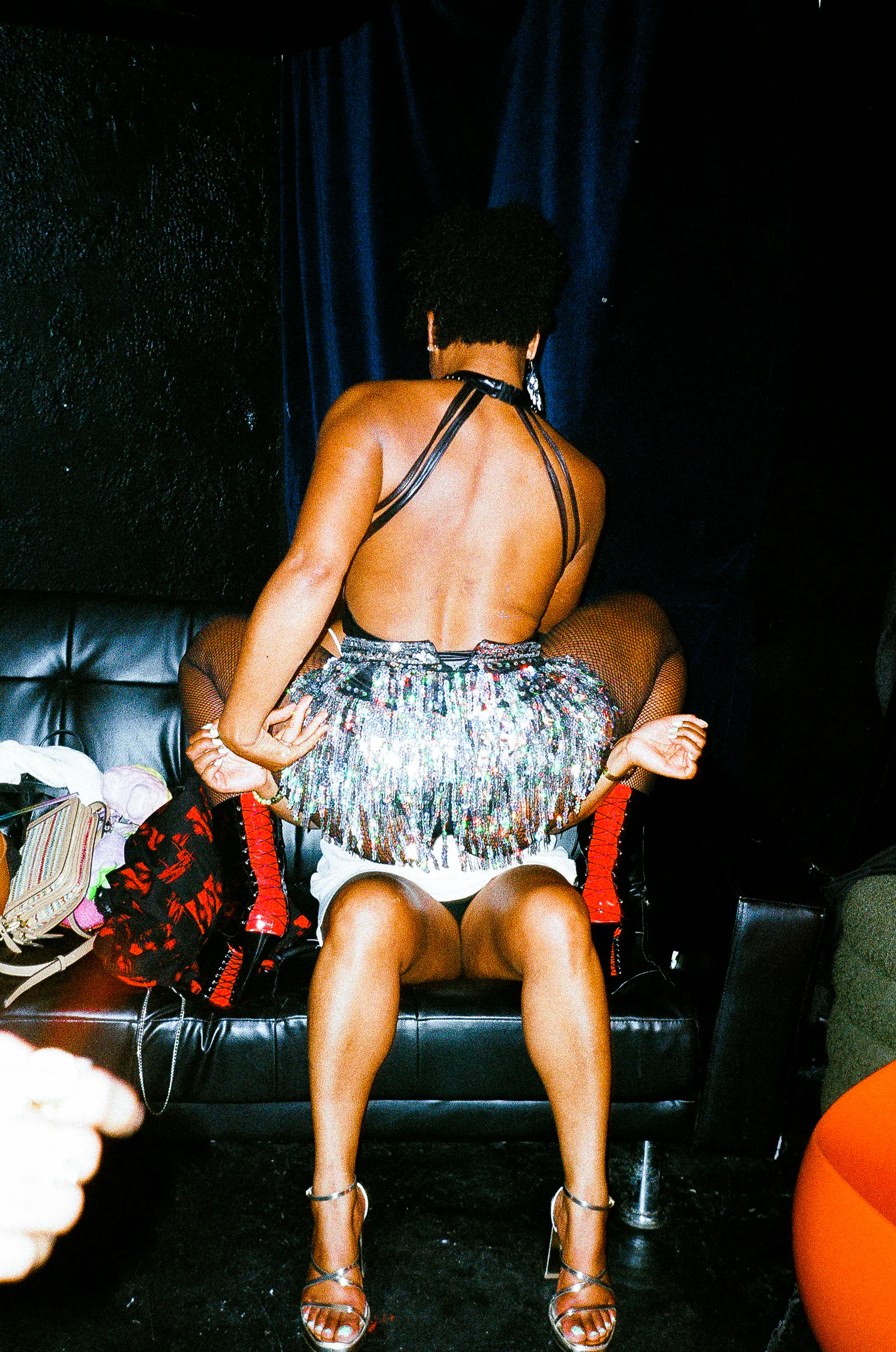
Mariana : The women who come to P3 tend to let loose because they know it’s a place where they can do just that. For example, if you come and have too much to drink, there will always be someone there to look after you and get you into a taxi. There’s a real spirit of sisterhood among all of our customers. They give each other lots of compliments; there’s absolutely no slut-shaming here. You can come dressed however you want – wearing almost nothing or fully covered – and we’ll always tell you, “You look good, baby!”
Stencia : P3 is a space where there’s no judgment among women, and I’m not just saying that because it’s our party (laughs). There’s no competition between us, and that feels so good. Nothing validates or invalidates the stories, identities, or physical appearances of those present. It’s very important to carry this supportive energy with us both inside and outside our events, and to make a difference at our own level.
Mariana : We want to make sure that everyone who comes feels comfortable and at ease. Even within the lesbian community, fems aren’t taken seriously; they’re often met with comments like, “You’re not really gay, are you?” The fact that we allow ourselves to be that way sometimes, and not at other times, also shows the girls who come to our event that they can feel free to show up however they want without having their sexuality questioned.
We’ve also started an Instagram group called the “P3 Babies” for newcomers, people who’ve never been before, or those who want to come alone, for example. They share photos of their outfits and meet up at cafes or bars before the party. It really builds strong bonds… in fact, we’ve already set up a couple, so “I’m like… maybe a wedding next!” (laughs).
What does the space you’re creating at P3 bring to the nightlife scene?
Stencia : For the first time, women can meet up without feeling like they’re in a gray area. In traditional party settings, women – and especially women of color – sometimes feel ashamed to embrace their sexuality and the fact that they’re queer. We’ve established shared values, and people come here knowing what to expect. We have a space of our own, just like gay men do.
Sephora : There is more collective pride associated with being gay than with being a lesbian, especially one of color.
Stencia : For us, as queer, lesbian, Black women, it’s really complicated… It takes a while for people to understand that this is a real identity, not just a phase.
Mariana : We’ve set an age limit at 21 for P3 because the people within our circle of friends, who are all in their thirties, need it. While the younger generations are very out and embrace their queerness openly and on social media, for example, I find that it’s more complicated for our generation. Another new aspect is the venue. Personally, we were tired of queer parties being immediately relegated to out-of-the-way and underground venues.
Mariana : I want to get ready to go out, to be welcomed with velvet armchairs, for it to smell nice, to feel comfortable, and to have a nice smoking room (laughs). We chose a chic neighborhood (in the 6th arrondissement, Saint-Germain-des-Prés), and it’s our way of saying that we want to claim that space, too. We don’t deserve places that are dirty, cold, poorly managed, and far from everything. We deserve spaces where we can feel like queens.
In your opinion, what sets P3 apart, and what makes your approach unique?
Stencia : First and foremost, we are deeply kind people, and we approach our project with this value in mind. Since we’ve been working in this field, we’ve realized that kindness isn’t a prerequisite or a particularly common value. We do things for the right reasons, with heart, with a genuine purpose and ambition. In our opinion, when you approach your projects with this authenticity, people notice it and are more receptive to your message.
Sephora : We have a chic brand image; we want to bring a certain level of sophistication and a very creative flair, particularly through the themed events we host – which undoubtedly stems from our connection to the ballroom scene. When you prepare for a ball, you don’t go there to win, but to show that you’ve already won; we love that attitude and attention to detail. In terms of artistic direction and communication as well, we’re perfectionists and always want to push ourselves to the limit.
Stencia : The marketing side is handled by Sephora, who does an exceptional job and has a well-thought-out strategy. That’s also one of the reasons behind P3’s success – we choose to tell stories at every event. This changes how people perceive the events and the narrative that we highlight. It’s a part of the process that’s invisible to the general public, but everything is meticulously planned and organized. It’s important to know that organizing events like this isn’t easy; it requires constant work. It’s very time-consuming and complicated given everyone’s respective careers. I think we can be proud of ourselves. It’s also key to do this work to pave the way for others, show that it’s possible, and serve as a role model.
What reactions have you had to the fact that your parties are intentionally single-sex?
Mariana : Gender segregation is a very complicated issue in France. In Berlin, where I’ve just come back from, it’s okay to hang out exclusively with women and/or with Black women. The culture is different, and the idea of sticking together is accepted because people there can share similar experiences. There’s a lot of hypocrisy in France, with many unspoken issues and a lot of negativity.
Sephora : French history is so fraught with issues that it’s impossible to speak concretely about it today. For example, it’s forbidden to compile statistics or collect ethnic data in order to get an accurate picture of the situation facing people of color in France. We always talk about violence in general terms; we won’t call things by their proper names.
Mariana : This also prevents people who aren’t directly affected from engaging with these issues. I'm referencing Berlin again because it’s a recent experience, but for example, at a lesbian bar during Black History Month, the lineup consisted entirely of artists of color, and more importantly, the audience also took the opportunity to discuss anti-racist issues openly. It is uninhibited there.
Stencia : France has a problem with labeling things, which overlooks the community’s key, and necessary, role. People want to assimilate us, or have us all be the same, even though individual stories must be taken into account. The principle of universalism erases distinctions, whereas it is necessary to take those distinctions into consideration. We are aware that a space like P3 can be intimidating, because we come with a strong premise – we want to be among a range of people, from women to transmasculine people, particularly those of color.
Mariana : A recurring comment, in fact, concerns our openness to transmasc individuals, to which we always give the same response. These people have very few safe and welcoming spaces available to them where they can meet others in a secure environment. As members of marginalized communities ourselves, we feel we have a duty to provide spaces for those who lack them. This is a group that is drastically underrepresented. Our rainbow is so broad that we have no problem welcoming them, even though we call this event “women only” and know that this might scare some people away. Those for whom the event’s title isn’t an issue are welcome. After speaking with some of the people involved, they pointed out that when you transition, people try to box you into a certain identity, even though some of them are gender fluid, non-binary, etc. We’ve had the support of prominent gay figures, notably Kiddy Smile and Matyouz, who understand our need to create our own spaces.
Stencia : P3 is a party that isn’t against anyone; it’s a party for women and trans men. Once you shift your perspective and way of looking at things, you’ll understand that we don’t want to exclude anyone. In fact, this approach already exists and is better understood within the gay male community.
Does being in a single-sex environment change your perception of a club’s atmosphere? Based on your experiences, does the atmosphere change depending on who is there?
Sephora : One major change is that we’re no longer exposed to the gaze of cis men. Speaking for myself, as I grew up, I found it increasingly hard to see myself through the lens of the male gaze, especially once I started coming out as a queer person at age 24. P3 creates a space where women aren’t pitted against each other. We can also freely say yes or no in romantic situations, without any hang-ups. Plus, you really feel that London vibe – which you don’t get at all in Paris – with girls approaching you with a “hey babe, you look fab!” on the subway, on the street, in clubs…
Mariana : I’ve been to all kinds of venues and clubs because dancing is what really matters to me. Thanks to my experiences, particularly those with La Créole and the Funky French League, I’ve learned to create my own space for well-being, freedom, and dance wherever I am, and that’s exactly what we want to instill in the people who come to P3. We invite them to use their whole bodies, especially their hips, and, above all, to use the entire space, particularly on stage, without any inhibitions.
Stencia : When I’m out at a party, I’m lucky enough not to pay much attention to how others might look at me; I have a knack for creating my own little bubble. But this space has given me a sense of freedom that I couldn’t find anywhere else, and above all, it has helped me embrace my identity. Being queer is very special to me, so we need spaces that cater to all these specificities, and where we can experience who we want to be. We have a special way of loving, seducing, and existing in this world.
« P3 is a party that isn’t against anyone; it’s a party for women and trans men. Once you shift your perspective and way of looking at things, you’ll understand that we don’t want to exclude anyone. »
Sephora : Stencia, do you think your experience differs from ours as a dark-skinned person of color?
Stencia : Yes, absolutely. I think that when you’re a dark-skinned lesbian, you’re not represented anywhere to begin with. On top of that, there’s this feeling that you’re always less desirable than others. There’s a lot of colorism, even in queer and racialized spaces. It’s a reality, so I call it out, even though I try to deconstruct it. Being in nightlife spaces like P3 has allowed me to accept myself as I am and to feel desirable.
Mariana : Even in our work, our skin colors can lead to us to being constantly categorized and always booked for roles like the side chick, the warrior, the refugee, the tomboy…
Sephora : We’re trying to break down these categories within P3 by challenging our own identities, and offering diverse representations of women who look like us and the world at large. We want to get our message across: you can be whoever you want to be.
To wrap up this conversation, what are your ambitions and visions for the future?
Sephora : Hosting events is just one part of the P3 project; it’s the first step. We’re already thinking about expanding this concept to other cities and countries if possible, with new formats, like the one we’ll be testing on June 22 leading up to June 23, 2023, at Le Mazette for Pride, featuring talks on various topics and wellness activities – all in an effort to cover as many aspects of femininity as possible. But above all, we want to create a community. We’re already part of several communities, but none that fits us exactly. It’s precious to have your own community, to better understand one another, to talk to each other, and to meet up.